Spital

Spital Mills History – part 3

This is the final part of our history of Spital Mills, Hasland. It covers the period after tobacco manufacturing ceased at the mill, bringing the story right up-to-date.
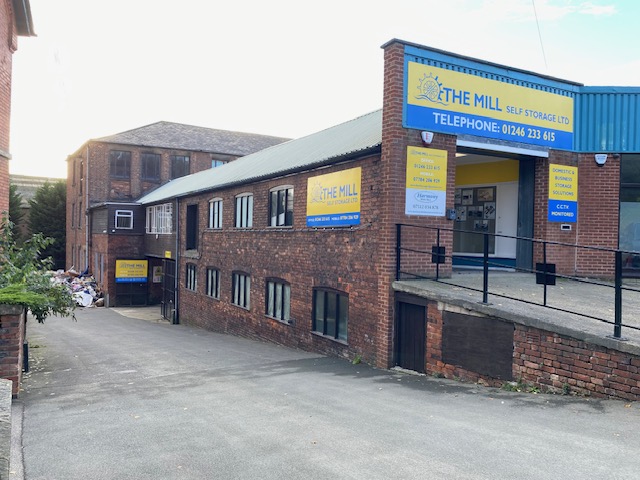
Today the old mill premises are mainly used as a storage facility. the original building is to the bottom of this photograph, taken in October 2023, looking down the mill yard from Spital Lane.
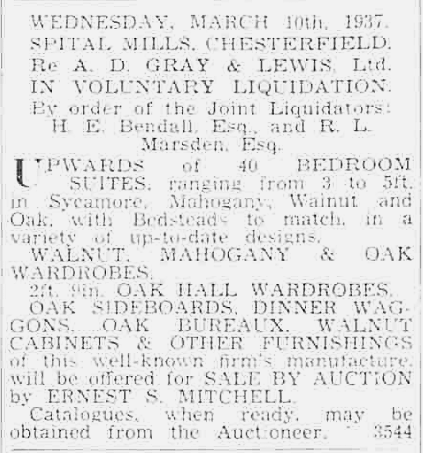
An advertisement in the Derbyshire Times 26 February 1937 for sale of liquidated stock at Spital Mills

After Mason’s tobacco manufacturing business closed in the early years of the 20th century, Spital Mills were taken over by A.D. Gray, who with a partner, established a cabinet making business there, trading as A.D. Gray & Lewis Ltd. In 1916 the company bought the freehold of the works.

Although the company was said in 1935 to be thriving, it went into voluntary liquidation early in 1937, when 40 bedroom suites were sold by auction. Later that year there was a two-day catalogue sale of the premises, the whole of the woodworking machinery, a gas engine, two electric motors, a large number of tools, 27,000 ft of oak and other plain timber and 40,000 ft of walnut, mahogany, oak, sycamore and other veneers.

Spital Mills were acquired in 1937 by the Woodseats Joinery Company, which in 1949 was purchased by Frederick Wale. He had, in 1912, served an apprenticeship at Gray & Lewis.

In the 1950s the business moved away from joinery to the manufacture and sale of tiled fireplaces and was renamed the Spital Tile Surround Company. The name was shortened to Spital Tile Co. Ltd when the business began to supply ceramic wall tiles.

Frederick Wale died in 1964, when the company passed to his son Ian. In his hands, the business diversified into the supply of plumbing and heating materials, ironmongery and tools to the trade, while still selling tiles.
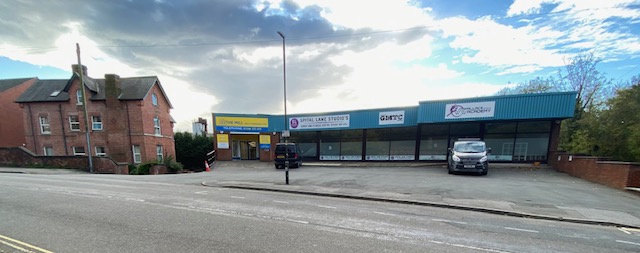
The frontage to Spital Lane in October 2023. The large extension to the left dates from 1981 and was latterly used as a bathroom and kitchen showroom. It is currently used as the premises of a dance studio.

In 1981 the company built a 5,500 sq. ft showroom on Spital Lane, in front of the mill, to promote the retail sale of bathrooms, kitchens and other products. The sale of gas fires and fireplaces was resumed in the 1990s, when Ian Wale was joined as directors by his daughters Victoria and Elizabeth.
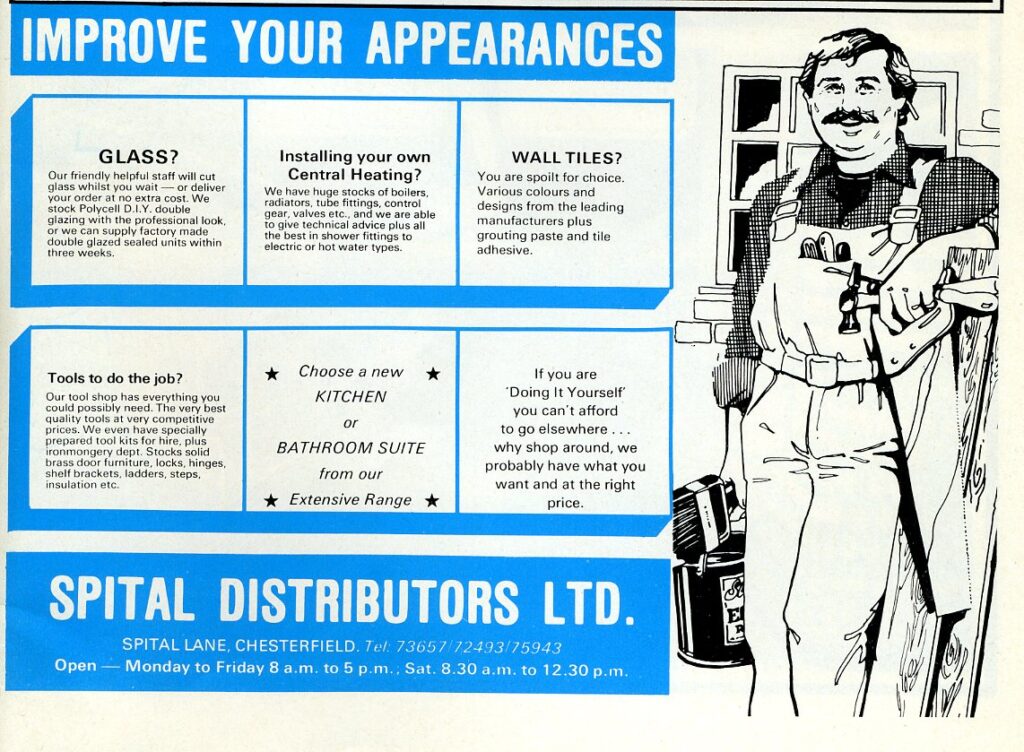
A 1981 advertisement for Spital Distributors. (Taken from a Derbyshire Times special supplement on Chesterfield).

The business closed in 2019. The former mill building was taken over by a storage company and the show room became a gym and dance centre. Both continue to this day.

Between 1954 and 1963 part of Spital Mills were occupied by the Midland Light Pattern Co., which moved to Chesterfield from Annesley Woodhouse (Notts.) in the former year, and from Spital Mills to a new factory at Calow in the latter year.

The mill erected by Holmes & Smith back in the 1840s, today survives substantially unaltered. The main building is of brick, of three-storeys beneath a hipped slate roof. An extension at first-floor level over part of the yard provided additional rooms, which in the 1930s were used as offices. There were other outbuildings adjoining and originally a boiler house with tall chimney and engine-house at one end of the mill, which had been demolished by 1937.

The mill stood within easy reach of the Midland Railway goods yard and later that of the Great Central Railway, but was never rail connected.

Our other parts of the story of Spital Mills can be found as below:

This text is a slightly edited version of that appearing in our ‘History of Hasland …’ book, which is now of print, but you can find copies in Chesterfield Local Studies Library. All sources are fully referenced in our book.

On 13 January 2024 we amended the original post to include a 1981 advertisement for Spital Distributors.

Spital Mills History – part 3 Read More »
Spital Mills History – part 2

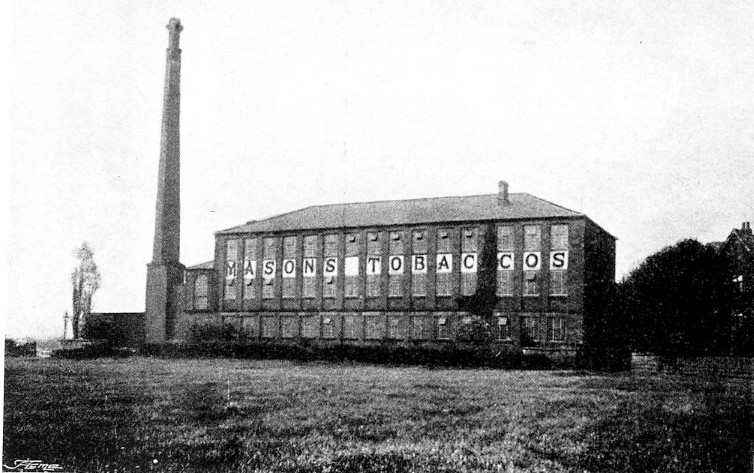
This is part two of our history of ‘Spital Mills’ – more recently known as the premises of Spital Tile. This time we look at the mill as a centre of tobacco manufacturing.

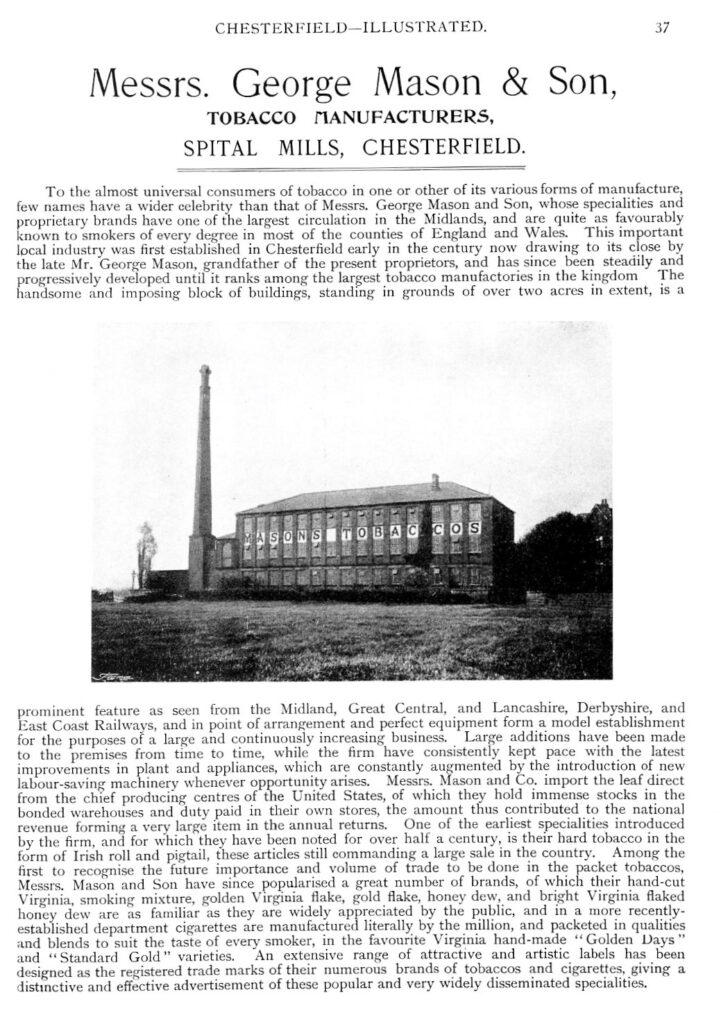
Spital Mill as pictured in the c. 1899 ‘An illustrated guide to Chesterfield’. By this this it is occupied by Mason’s tobacco factory.

In the early 19th century George Mason, born at Cutthorpe (in Brampton) in about 1794, was a tobacco manufacturer in Chesterfield, with premises at 45–47 and 49–51 Low Pavement (either side of Wheeldon Lane). Here he had a works powered by a horse-gin, making cigars and twist tobacco. He was employing six men in 1851.

Mason died in 1854, leaving personal estate of £4,000, when the business, henceforth known as George Mason & Son, passed to his second son Edwin, born about 1829. He was living with his wife and family in Mason’s Yard, behind Low Pavement, in 1861, when he had 15 men, ten girls and two boys working for him.

A few years later, as the business grew rapidly, Mason moved to the former lace mill on Spital Lane – our Spital Mills and bought Spital House as a residence. By 1871 he had 116 employees at the tobacco works.

Edwin Mason died in 1887, leaving personal estate of £44,030. He was the sole owner of George Mason & Son, which was described as one of the largest tobacco manufacturers in England. He concentrated on business rather than engaging in public affairs, and was ‘retiring and unambitious’. In the 1880s the company was said to employ more young women than any other concern in the town.

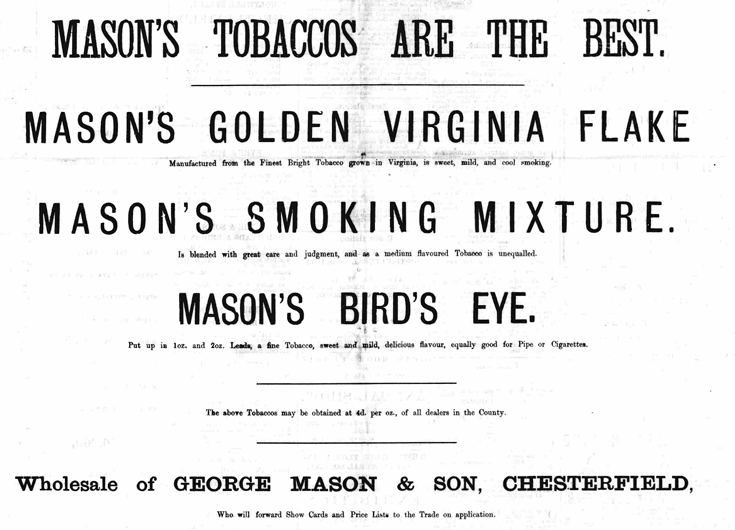
One of a short series of half-page advertisements in the Derbyshire Courier – this one from the edition of 28 June 1887.

Edwin’s two sons, Oscar Edwin and Charles Leonard, succeeded to the business just as tastes were changing and the demand for twist tobacco was falling. They tried to move into cigarette making, advertising repeatedly over two years in 1892–4 for ‘up to 40 respectable young girls’ to learn the ‘clean and light work’ involved. They also, immediately after their father’s death, rather extravagantly took a half page advertisement in the Derbyshire Courier for several weeks to promote the company. Their final undoing was the creation of a tobacco combine by the larger British firms, in an attempt to meet American competition. Masons were not included and found their old markets closed to them.

Advertisement in the Derbyshire Times, 6 February 1892.

Another reason for the decline of what was clearly a very successful company in their father’s day appears to be loss of interest on the part of his sons. Oscar initially lived at Spital House but, after the estate was sold to the Lancashire, Derbyshire & East Coast Railway in the early 1890s, moved to Dunston Hall  (in Newbold), where in 1901 he was employing a governess and eight servants, several more than his father ever had.

Oscar remained at Dunston Hall until he died, aged only 45, in 1903, when he left a modest £1,283. An obituary made no reference to his business career, but described him as an enthusiastic sportsman.

Oscar died after returning home early from a race meeting at Doncaster; he and his family were then staying at Bridlington (Yorks.). Many years later it was said that he had  ‘always been largely interested in racing and sport’. His widow Mary Ann died at Frimley (Surrey) in 1936.

The business came to an end soon after Oscar died. In 1901 both he and his brother Charles, who was then living with his family, a governess and three servants in a house in The Crescent, Scarborough (Yorks.), gave their occupation as tobacco manufacturer, but Charles was a ‘late tobacco manufacturer’ in 1911, when the family were living in rooms in Cheltenham (Gloucs.) with no servants.

Charles later lived at various places on the South Coast and died at Portsmouth (Hants.) in 1935, leaving personal estate of just £20.24.

This brings to a close the tobacco manufacturing story of Spital Mills – but there is more to come in our next post.

The full entry for the tobacco factory from the c. 1899 book ‘An illustrated guide to Chesterfield’.

Part one of our history of Spital Mills can be found here.

The next and final part of our history can be found here.

This text is a slightly edited version of that appearing in our ‘History of Hasland …’ book, which is now of print, but you can find copies in Chesterfield Local Studies Library. All sources are fully referenced in our book.

Spital Mills History – part 2 Read More »

Successful Hasland book launch

The evening of the 15 June, saw a successful launch for our new book on the history of Hasland.

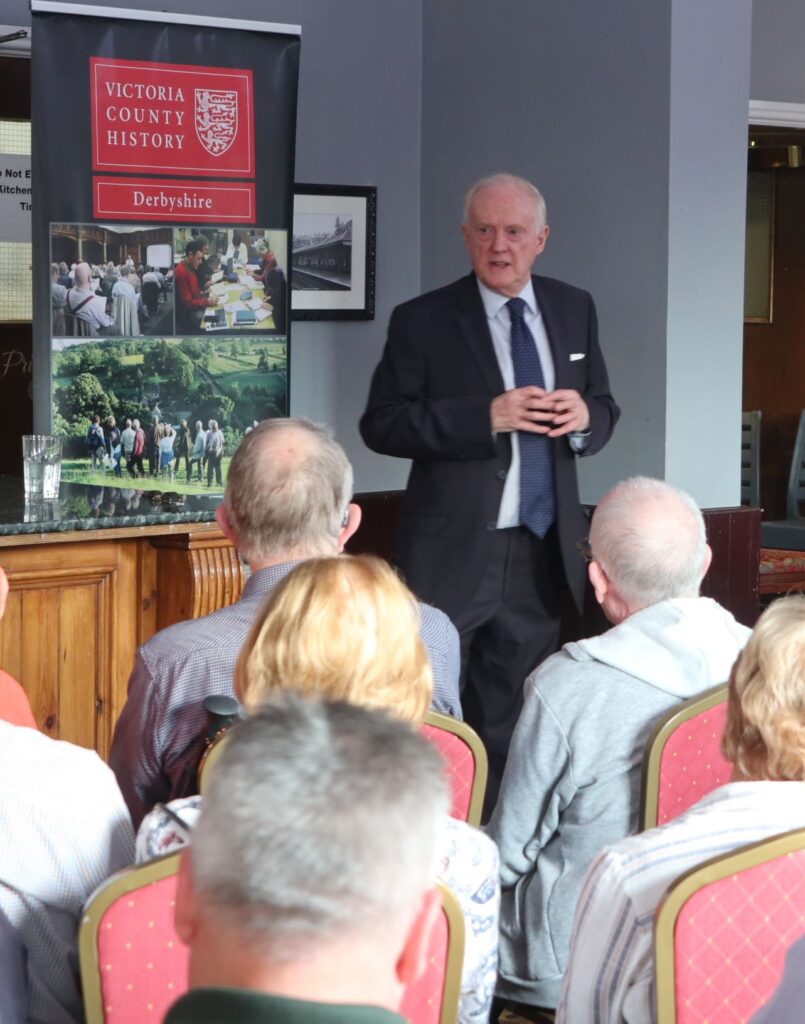
Philip Riden, VCH County Editor, talking to a packed audience at the Devonshire Arms during the launch of a new book about Hasland’s history.

Launched at the Devonshire Arms in the village, it was a capacity audience of over 60 people who attended the event. Our County Editor, Philip Riden, explained about what VCH does and gave a brief overview of the history of this formerly large parish, which used to comprise Spital, Hady, Boythorpe, Grassmoor, Winsick, Birdholme and Corbriggs.

The beginnings of the township, its growth, economic history, religion, education, landownership and local government were amongst topics covered. Large-scale industry like the former Chesterfield Tube Works got a mention, along with the less well-known story of local mining and the Broad Oaks furnaces near Storforth Lane were mentioned.

Priced at £20 the book is of some 200 pages, with colour illustrations and maps. The A4 sized hardback book should hopefully soon be available at Waterstones in Chesterfield and the town’s Visitor Centre. It is also available from the VCH by using an online order form at https://bit.ly/HistoryofHasland and from Hasland Coop.

The Trust’s first publication in this VCH spin-off series, Chesterfield’s Streets and Houses, is still available. The next spin-off book should be an account of Temple Normanton and Calow.

Our thanks to everyone who attended and to the Devonshire Arms for providing the venue.

Philip Riden, Derbyshire VCH County Editor, far right, with some of the volunteer group who have contributed to the new book on Hasland. Holding the book, centre, is Lyn Pardo Roques, Chair of the Derbyshire VCH Trust.

Successful Hasland book launch Read More »

You’re invited to our 15 June Hasland book launch

No apologies for advertising our nee Hasland book’s launch on 15 June, in this blog.

Pop along to see us at the Devonshire Arms, Hasland, starting at 7.30pm. There’s no admission fee and you’ll be able to hear our county editor Philip Riden, give a short account of the book and the formerly extensive parish of Hasland. You’ll also be able to purchase the book if you want to.

Our Hasland book
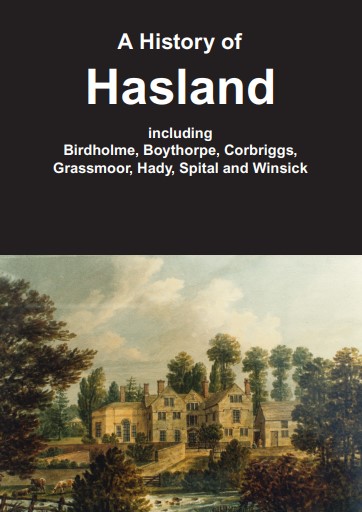
Our Hasland book cover, by kind permission of Derbyshire County Council, features Spital House. Our last blog looked at this now disappeared property.

Published on behalf of the Derbyshire Victoria County (VCH) Trust, the book represents hours of research by a group of volunteers, under the guidance of VCH county editor Philip Riden. They have been busy researching the history of Chesterfield for around 20 years. Although this is the second publication as a result of this work, it is the first to look at an actual area of Chesterfield and the north eastern part of the county – and more are set to follow.

The book looks at Hasland’s history through the ages, charting the many communities that once made up its historic area – Spital, Hady, Boythorpe, Grassmoor, Winsick, Birdholme and Corbriggs. The beginnings of the township, its growth, economic history, religion, education, landownership and local government are amongst topics covered. Large-scale industry like the former Chesterfield Tube Works gets a mention, along with the less well-known story of local mining, the Broad Oaks furnaces near Storforth Lane and many others.

Philip Riden described the history as the fullest account of the history of Hasland published so far, and the first ever attempt to write the history of Grassmoor or Birdholme. He commented; ‘Our work on Hasland was well progressed, and so we thought there was a need to bring this together and publish it. Hopefully, local people will find the book of interest. It’s really an interim account of the township as we aim to produce a volume of the Victoria County History for the area.’

At some 200 pages with colour illustrations and maps, the A4 sized hardback book will be available to purchase at the launch and afterwards at Waterstones in Chesterfield and the town’s Visitor Centre and from the publisher Merton Priory Press (mertonpriory.co.uk). It’s priced at £20 (plus postage and packaging).

Philip Riden comments; ‘We hope that by publishing our research it will herald a new understanding of the area’s varied past. All VCH accounts are well-researched, fully indexed and have copious references, so that anyone interested can look up our sources and research things further if they want to’.

The Trust’s first publication in this spin-off series, Chesterfield’s Streets and Houses, is still available. The next spin-off book will be an account of Temple Normanton and Calow.

To find out more about the launch event visit our events page.

You’re invited to our 15 June Hasland book launch Read More »

Hasland book launch date 15 June 2022

Our new Hasland VCH spin-off book is to be published at a launch event on the evening of 15 June at the Devonshire Arms, Hasland.

Our Hasland book

The book will be the first authoritative account of this large parish.

Until 19th-century boundary changes, the township (later civil parish) of Hasland (near Chesterfield) included not just what people think of as Hasland today but also Corbriggs and Winsick, Grassmoor, Birdholme and the St Augustine’s end of Boythorpe. It formerly included much industry on Derby Road. We’ve recently been featuring some of the many varied subjects covered in the book in our blog. You can rad more about why Hasland has been chosen for our first township based spin-off book in our blog.

With colour plates, of just over 200 pages, A4 in size, we think that this will be a landmark publication in the history of the area. The book will be available for £20 at the meeting. We also hope to make it available in Waterstones bookshop in Chesterfield and by post from the publisher (additional postage of £5 will apply).

The launch event, which is free to attend, will be held on Wednesday 15th June starting at 7.30pm in the function room at the Devonshire Arms, Hasland. To find out more about the launch event visit our events page.

Hasland book launch date 15 June 2022 Read More »

Hasland’s place name

How did Hasland, Spital, Hady, Boythorpe, Grassmoor, Winsick, Birdholme and Corbriggs get their names? In this blog we’ll take a very brief look at place names associated with our forthcoming book on the former large and varied Chesterfield township of Hasland.

Let’s start with Hasland itself. This name has its origins in ‘Haselont’ (mentioned in 1129-38). It actually means hazel grove. Presumably the township could well have assumed this name which is more associated with of Hazel Grove near Stockport in Greater Manchester.

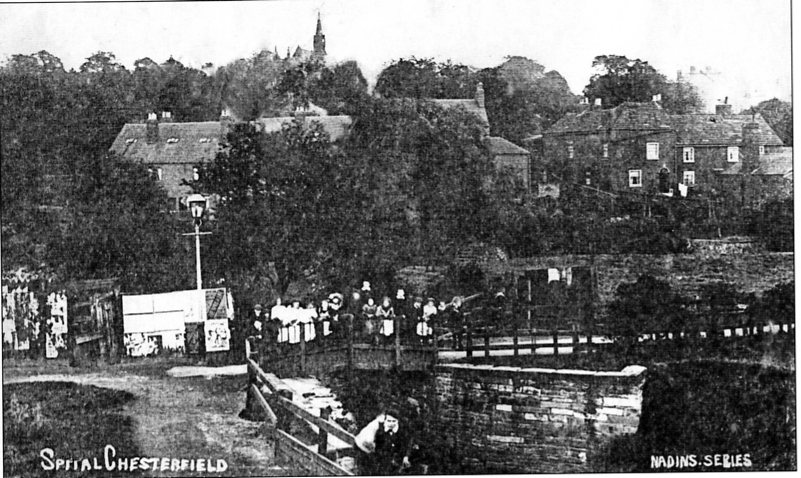
In this blog we explore the origins of the names of some of the groups of communities who made up Hasland township. As our forthcoming Hasland book relates, the development of the suburb known today as Spital began with the building (at some date between the 1830s and 1870s) of Spring Vale, on the west side of Spital Lane a short distance south of Spital Mills. The area is pictured in this Nadin postcard of around 1900. (Courtesy Lyn Pardo Roques).

Spital is quite clearly named as such due to the the leper hospital, dedicated to St Leonard, from which the modern suburb takes its name. This hospital was first mentioned in 1195.

Hady is not so clear. There’s a le Hady mentioned in 1468 and Had(e)y in 1635. It’s thought the first element may mean headland (‘heafod’). The second element may mean an island or enclosure.

The northern end of Hasland township, between the boundary with Tapton on the north and Calow on the east, the Rother on the west and Spital Brook on the south, became known in modern times as Spital (on the west) and Hady (on the east). The growth of housing on this side of Chesterfield in the 20th century led to the fusion of Spital and Hady into virtually a single built-up area.

The only place in Hasland township mentioned in the Domesday Survey (1086) is Boythorpe – ‘Buitorp’. This is a straightforward name; it is definitely Boie’s outlying farm, i.e. a personal name plus torp (farm), which still has the same modern meaning in all three Scandinavian languages.

Grassmoor‘s name is perhaps a little more complex. It could, of course, simply refer to a grass moor (rough, uncultivated land). Indeed when the area was enclosed in 1781 it was called ‘Grass Moor’. But there was a former Deincourt estate in Hasland, which, in medieval times, included Alvin Wood and Greyhirst Moor. There may have been a transition from ‘Greyhirst’ to ‘Grassmoor’, but there is no etymological (historic word) connection between the two. Greyhirst appears to have been where Grassmoor is now. There’s a 1549 mention of ‘Gresmore’, by 1568 we have ‘Grasmoore’. Alvin Wood, incidently, was definitely in North Wingfield.

Winsick may be identified with Winwell Sick (river or stream) mentioned in 1488. The actual origin of the name is unclear.

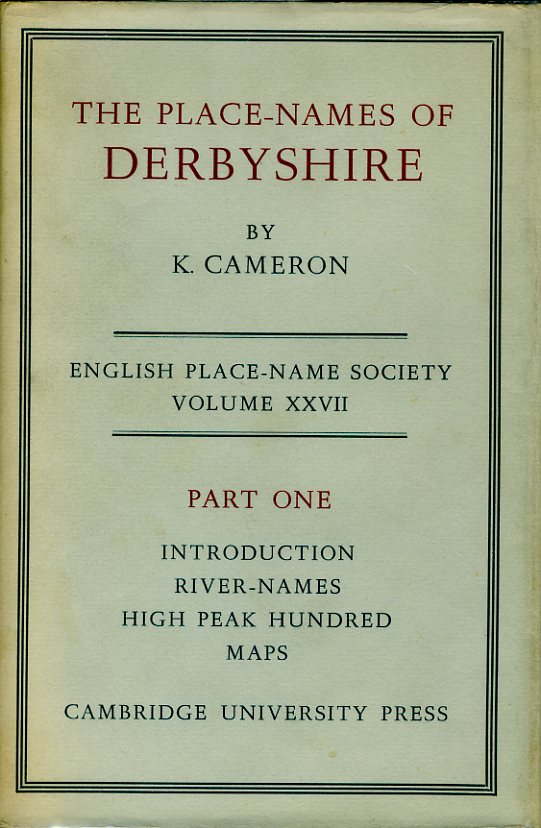
Cameron’s three-volume ‘Place Names of Derbyshire’ is still the authoritative source for place name information, though we have supplemented it with new research for our book on Hasland.

Birdholme cannot be easily explained. Cameron in his ‘Place Names of Derbyshire’ mentions two name elements – bridd and holmr. This has been interpreted as (a) a young bird, (b) island, raised land in a marsh, river meadow. We think Cameron thought the name origin was something like ‘riverside meadow with birds’ but he couldn’t find any early forms and neither have VCH in our research. The evidence is therefore not conclusive. Holmr is most commonly thoughout of as ‘island’ (modern Holme, as in Steep Holme, Flat Holme etc.) but doesn’t fit in the the case of Birdholme (nor, for example, in Holmewood).

Corbriggs‘ origin is also unclear. It is possible that the (now unnamed) stream, over which the bridge takes Mansfield Road, could have been the ‘Corr/Caw/Carr Brook’ but there’s no evidence one way or the other. In 1630 we find a ‘Cawbridge Meadowe’. By 1840 Corbridge is mentioned. In the early 1830s Sanderson in his map of twenty miles around Mansfield named the bridge carrying Mansfield Road over the then unnamed stream ‘Corr Bridge’. So, the ‘… briggs’ bit is probably corrupted from bridge. Only part of Corbriggs is in Hasland township – the rest is in Temple Normanton.


Our forthcoming Hasland book will cover the history all the above areas. For more details about place and river names see ‘The Place Names of Derbyshire’, in three volumes, by K. Cameron.

Hasland’s place name Read More »

Our Hasland book is on the way

Our Victoria County History spin-off book on Hasland, after some delay, is in the final stages of preparation. You can find out more about the book in this blog.

Our VCH County Editor – Philip Riden – has brought together hours of work by our Chesterfield research group, for the first authoritative history of this expansive parish. It’s written in our usual VCH style, which means there’s lots of source references and a thorough index for those wishing to explore more about the story of Hasland.

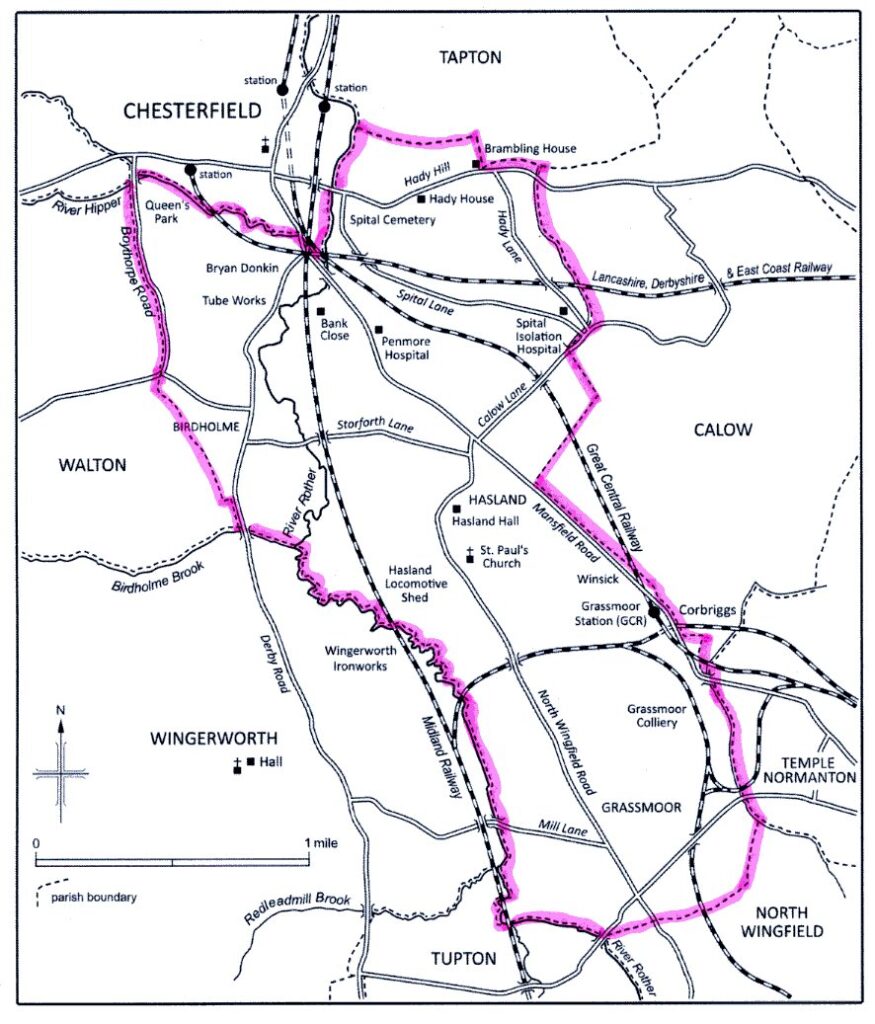
Hasland, but not as you know it? Our book will cover the once historic parish – marked by the highlighted boundary. It was much bigger than what we now regard as Hasland.

But what many people now regard as the modern Hasland, was much more extensive. Our map above (from the book) shows just how big Hasland parish once was. At one time it comprised not only what we now call Hasland but also Grassmoor, Winsick, Spital, Hady, parts of Boythorpe and Birdholme. It also included much of Chesterfield’s former heavy industry including the Tube Works and Bryan Donkin’s premises on Derby Road. No wonder the book will number some 200 odd pages.

As is standard in VCH, there’s sections on landownership, economic, social and religious history and local government. Within these sections are histories on such diverse topics as the Reema concrete plant based at the former Broad Oaks blast furnaces (itself covered), SS Augustine’s church and other places of worship, local collieries, Penmore hospital and many others. Lessor remembered features such as the Grassmoor and Hasland cinemas, tobacco and textile manufacture also feature.

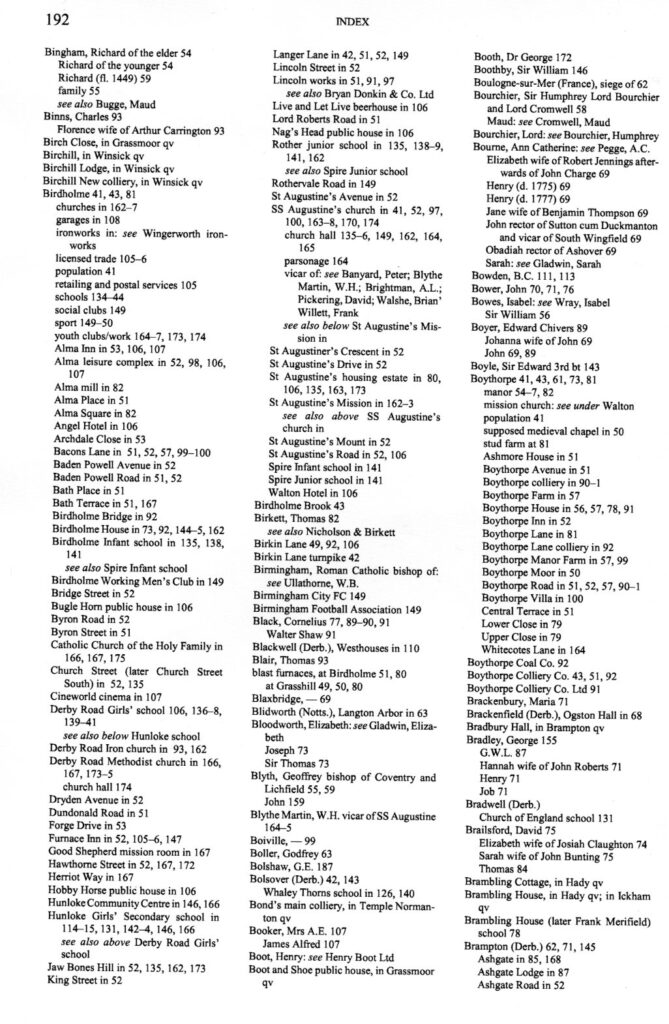
Our second extract from the book is a page from the index, which gives a snap-shot of a few of the items covered. Illustrations and maps will also feature in the publication.

A sample page from the index to our Hasland book.

We’ll be keeping you up-to-date with progress on the book, which should be published around May this year. In the meantime we’ll feature some of the stories from the publication in our blogs.

This is the second VCH spin-off publication. Our first – ‘Chesterfield Streets and Houses’ – is still available.

Our Hasland book is on the way Read More »